
Key Publications and Presentations:
CO2REMOVAL FROM NATURAL GAS
Problem
CO2 is found in natural gas in many locations and must be removed to meet specifications before the gas can be delivered to the pipeline. Availability of a simple process technology that can be applied in remote, unattended, or offshore situations is highly desirable. Ease of operation, quick start-up, and high on-stream factors are needed in addition to competitive capital and operating costs.
Amine systems are used frequently but are complex and have high capital, operating, and installation costs; a relatively high fuel cost and potential environmental issues.
Membrane Solution
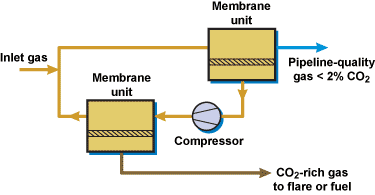
MTR’s membrane based systems provide a simple, low-cost, compact solution for reducing CO2 content in natural gas. These novel membranes have a unique polymer chemistry that is far superior to conventional membranes in withstanding the various components in natural gas. The membranes require minimal gas pretreatment and offer very high efficiency separation, with more than 95% hydrocarbon recovery achievable.
These membranes are used for achieving pipeline CO2 specifications of 4 mol% or less or for bulk CO2removal. Due to the high fluxes of these membranes and efficient module packaging, using MTR’s membrane process minimizes required deck space and weight in offshore installations.
MTR has commercialized several different types of membranes based on both glassy and rubbery membrane materials under different trade names. MTR customizes the overall separation solution using these commercial membranes in order to achieve optimal performance in the field and meet client requirements.
Benefits
- CO2 content reduced to required specifications (<2 mol% or optimal levels)
- Limited pretreatment required due to robust membrane chemistry
- Unique process design to maximize total hydrocarbon recovery
- High-efficiency packaging minimizes space and weight, making the units ideal for offshore applications
- Easy, low-cost installations. In many cases, single skid systems can installed in hours.
- Robust, proven membrane performance at high CO2 contents
- No regular maintenance, no moving parts, and designed for remote unmanned operation
- High on-stream times maximize revenues
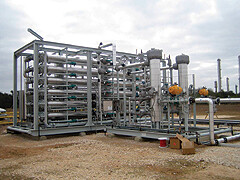
MTR supplied CO2 removal system operating at a Texas gas well
System Performance
- Feed Rate: < 1 MMscfd to > 300 MMscfd
- Feed CO2 Content: > 40 mol% to < 5 mol%
- Product CO2 Content: to < 2 mol%
- Hydrocarbon Recovery: > 95% +
Frequently Asked Questions
Can CO₂ removal systems handle fluctuations in Natural gas composition?
Yes, membrane-based CO₂ removal systems are highly flexible and can handle variations in natural gas composition and flow rates. Their robust membrane chemistry, flexible configuration and high efficiency membranes allow the system to adapt to changing CO₂ levels without compromising performance, making them suitable for both onshore and offshore applications.
How efficient is membrane-based CO₂ removal from Natural Gas?
Membrane-based CO₂ removal systems are highly efficient, typically achieving over 98+% hydrocarbon recovery, with performance reaching up to more than 98% in optimized systems. They can also reduce CO₂ content to pipeline specifications (often below 1-2%), ensuring high-quality output.
What are the advantages of membrane technology for CO₂ removal from Natural Gas?
Membrane technology offers several advantages, including a compact and cost-effective design, minimal pretreatment requirements, condensation-mode operation and chemical-free operation. These systems are easy to install, require low maintenance, and provide high operational uptime. Additionally, their modular structure allows scalability and flexibility for different project sizes.
Can membranes be applied to EOR applications with high CO2 content?
Yes, membrane-based CO2 removal systems are robust and highly flexible to handle CO2 content in the feed gas as high as 98-99%.