
MTR is the leading supplier of membrane system for hydrocarbon recovery from petrochemical plant vents.
problem
When polyolefins are produced in petrochemical plants, the PP/PE resin leaves the reactor saturated with un-reacted hydrocarbons. Before this “wet” resin can be used for the production of plastic containers (i.e. bottles, food containers, etc.), it is sent to a purge bin where it is purged with nitrogen to drive off the un-reacted hydrocarbons. As a result, an off-gas stream containing nitrogen and hydrocarbons is produced. This purge bin off-gas is usually burned at the flare header.
This off-gas contains a significant amount of hydrocarbons. Removing nitrogen from this stream upgrades it to fuel gas quality, so it can be used instead of purchased gas.
VaporSep® Solution
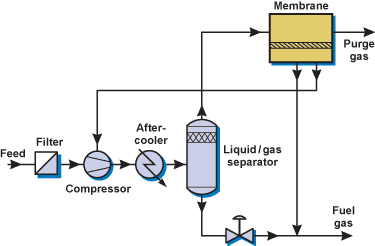
MTR’s VaporSep System can easily separate the C2+ hydrocarbons from the nitrogen, producing a hydrocarbon-enriched stream that may be used as a high quality fuel gas.
The purge bin off-gas is first compressed from atmospheric pressure to around 22 bar. The compressed gas is then cooled and passed through a gas/liquid separator. The gas leaving the separator enters the membrane unit, where hydrocarbons permeate to the low pressure side more readily than nitrogen. The first permeate stream is rich in hydrocarbons and is used as fuel gas product. The second permeate is recycled to the compressor suction to enhance hydrocarbon recovery. The nitrogen rich residue stream is the treated purge gas — from which most of the valuable hydrocarbons have been removed.
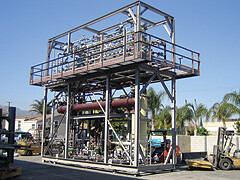
The VaporSep system includes a single low maintenance oil-flooded screw compressor, a membrane section and all ancillary equipment. The entire system is skid-mounted for easy installation.
Benefits
- Recovers a hydrocarbon-enriched stream (containing < 10 mol% nitrogen) that can be used as valuable fuel gas
- Drastically reduces the loss of hydrocarbons being burned in the flare
- Operates at ambient temperature and does not require any refrigeration or low temperature metallurgy – a simple system
System Performance
- Feed flow rate: 3 to 5 tons/hr
- Composition: 30 to 40 mol% nitrogen; 40 to 60 mol% C2+ hydrocarbons; balance hydrogen
- Pressure: 1.2 bar
- Temperature: 60 to 70 C
System Description
- Unit dimensions: 30 ft (L) x 10 ft (W) x 14 ft (H)
- Weight: 80,000 lb
- Compressor power requirement: 1,000 kW
Frequently Asked Questions
What are gas recovery systems and how do they work?
Gas recovery systems are technologies used to capture and reuse valuable gases that would otherwise be wasted or flared in industrial processes. In petrochemical plants, off-gas streams often contain a mixture of hydrocarbons and nitrogen.
Modern systems, such as membrane-based solutions, work by separating gases based on their permeability. The gas is compressed and cooled, then passed through membranes, where hydrocarbons permeate faster than nitrogen, producing a hydrocarbon-rich stream that can be reused as fuel while nitrogen is removed.
Why are gas recovery systems important in industrial plants?
Gas recovery systems are critical because they help industries reduce waste, improve efficiency, and lower operating costs. Without recovery systems, valuable hydrocarbons are often burned in flare systems, resulting in energy loss and emissions.
By recovering these gases, plants can convert waste streams into usable fuel, reduce dependency on purchased energy, and minimize environmental impact. This also supports better resource utilization and overall process optimization.
How to select the right gas recovery system for your facility?
Selecting the right gas recovery system depends on several factors, including gas composition, flow rate, pressure, and desired product quality. Facilities should evaluate whether their streams contain recoverable hydrocarbons and define their recovery goals.
Membrane-based systems are often preferred because they are compact, easy to install, and require minimal maintenance. Custom-designed solutions tailored to specific process conditions ensure optimal performance and maximum recovery efficiency.
How efficient are modern gas recovery systems?
Modern gas recovery systems, especially membrane-based technologies, are highly efficient and capable of recovering a significant portion of valuable hydrocarbons. These systems can produce fuel gas with low nitrogen content and high hydrocarbon concentration, making it suitable for reuse.
They also enhance overall plant efficiency by reducing hydrocarbon losses and improving fuel utilization, often delivering strong economic returns with simple operation and low energy requirements.