
CO2REMOVAL FROM BIOGAS (LANDFILL AND BIODIGESTERS)
Opportunity
CO2 is produced along with methane in landfills and biodigesters. In the past these biogas streams were flared or utilized as a fuel source for power generation. However, since this gas source is from wastes, it is considered renewable natural gas and if properly processed to meet pipeline specifications, it can be sold for a premium value to the gas grid. In order to make the gas ready for pipeline sales, several specifications have to be met. MTR’s simple process technology based on membranes that can be applied in both farm and landfill projects.
Other technologies, such as Amine systems, Water Wash and PSA are also considered as potential ways to remove CO2, however, in recent projects due to the various advantages, membranes have become the de-facto choice for these types of projects.
Membrane Solution
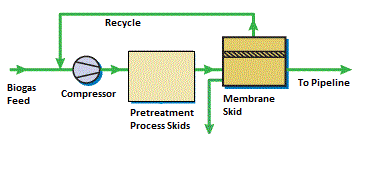
MTR’s membrane based systems provide a simple, low-cost, compact solution for reducing CO2 content in biogas. These novel membranes have a unique polymer chemistry that is far superior to conventional membranes in withstanding the various components in natural gas. The membranes require normal gas pretreatment and offer very high efficiency separation, with more than 95% and even upto 98% hydrocarbon recovery achievable.
Due to the high fluxes of these membranes and efficient module packaging which is available in various sizes, using MTR’s membrane process can be tailored very effectively to make current and future projected gas processing demand.
Benefits
- CO2 content reduced to required specifications (<2 mol% or optimal levels)
- Limited pretreatment required due to robust membrane chemistry
- Unique process design to maximize total hydrocarbon recovery
- High-efficiency packaging and availability of modules in various sizes makes for flexible skid construction, including containizing is possible.
- Robust, proven membrane performance at high CO2 contents
- High on-stream times maximize revenues
System Performance
- Feed Rate: < 200 scfm to > 8000 scfm
- Feed CO2 Content: > 30 mol% upto 90 mol%
- Product CO2 Content: to < 2 mol% or as required
- Hydrocarbon Recovery: > 95% + upto 98% possible
Frequently Asked Questions
Can CO₂ removal systems handle fluctuations in biogas composition?
Yes, membrane-based CO₂ removal systems are highly flexible and can handle variations in biogas composition and flow rates. Their modular design and high flux membranes allow the system to adapt to changing CO₂ levels without compromising performance, making them suitable for both landfill and biodigester applications.
How efficient is membrane-based CO₂ removal?
Membrane-based CO₂ removal systems are highly efficient, typically achieving over 95% hydrocarbon recovery, with performance reaching up to 98% in optimized systems. They can also reduce CO₂ content to pipeline specifications (often below 2%), ensuring high-quality biomethane output.
What are the advantages of membrane technology for CO₂ removal from biogas?
Membrane technology offers several advantages, including a compact and cost-effective design, minimal pretreatment requirements, and chemical-free operation. These systems are easy to install, require low maintenance, and provide high operational uptime. Additionally, their modular structure allows scalability and flexibility for different project sizes.
Can CO₂ removal systems handle fluctuations in biogas composition?
Yes, membrane systems are specifically designed to manage fluctuations in biogas composition. Their robust membrane chemistry and flexible configuration ensure consistent performance even when CO₂ concentrations or gas flow rates vary, maintaining stable output quality.
How does CO₂ removal from biogas support sustainability goals?
CO₂ removal upgrades biogas into renewable natural gas (RNG) or biomethane, which can be injected into pipelines or used as a clean fuel. This process reduces greenhouse gas emissions, converts waste into valuable energy, and supports circular economy practices by utilizing organic waste streams efficiently.