
Because of their simplicity, SourSep™ units do not need a myriad of redundant components to ensure reliability.
Challenge
Sour gas is an inconvenience right from the wellhead. Membranes can be used for bulk removal of H2S upstream and combined with downstream facilities to polish the treated gas to meet pipeline specs. Upstream bulk removal can be combined with re-injection of the H2S to unload downstream sweetening and sulfur production facilities.
Membrane Solution
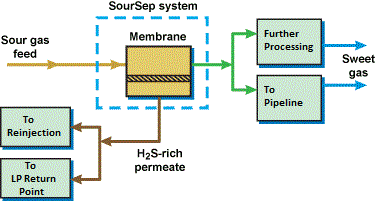
MTR’s SourSep™ systems bulk remove H2S from pressurized sour gas in a simple single stage process. Bulk removal (>75%) will generate a very sour low pressure permeate gas which can be re-injected. The unit is simple, has no moving parts, no absorbents or adsorbents and processes only gas. No liquids or solids are used or produced. The incoming high pressure sour stream is split into a moderately sweetened high pressure product stream and a low pressure H2S rich reject stream.
SourSep™ bulk H2S removal can be combined with reinjection or (ii) other direct H2S to S conversion processes H2S disposal. Moderately sweetened product gas can be polished using (iii) lightly loaded conventional amine units with existing Claus facilities.
For H2S removal from fuel gas — see MTR leaflet “Fuel Gas Conditioning”
Benefits
- Simple bulk H2S removal down to 200-300 ppm
- Product gas with low hydrocarbon and water dewpoint
- Robust, proven membrane performance at high H2S content
- Skid mounted equipment, can be trucked to site and installed fast
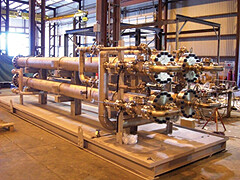
SourSep™ unit for installation on an Indonesian remote production field
System Performance
- Feed flow rate: Wide range from 1 MMSCFD to >100 MMSCFD for appropriate applications
- Feed H2S content: >5% to <100 ppm
- Product gas pressure 30 to 1200 psia
- H2S reduction up to 90% possible
Application Options
- Bulk upstream removal
- Minimize scavenger loading
Frequently Asked Questions
Why is it essential to remove H₂S from natural gas?
Removing hydrogen sulfide (H₂S) is essential because it is toxic, corrosive, and harmful to equipment and infrastructure. Its presence in natural gas can damage pipelines, processing units, and engines, while also posing serious health and safety risks. Additionally, untreated H₂S can make gas unsuitable for transport or use.
How does H₂S removal improve natural gas quality?
H₂S removal significantly improves natural gas quality by producing a cleaner, safer, and pipeline-compliant gas stream. It reduces corrosion potential, lowers acid gas content, and ensures the gas meets required specifications, making it suitable for commercial use and transportation.
What are common methods used for H₂S removal in natural gas processing?
Common methods for H₂S removal include amine treatment systems, chemical scavengers, and membrane-based separation technologies. In many applications, membrane systems are used for bulk H₂S removal and can be combined with conventional processes for final polishing to meet strict pipeline standards.
How do membrane systems work for H₂S removal?
Membrane systems, such as MTR’s SourSep™, work by separating H₂S from natural gas based on selective permeability. The high-pressure gas stream passes through the membrane, producing:
A sweetened gas stream (low H₂S)
A low-pressure stream rich in H₂S
These systems can achieve significant bulk removal (often up to 75–90% reduction) in a simple, single-stage process without using chemicals or moving parts.
How does H₂S removal impact environmental compliance?
H₂S removal is critical for environmental compliance by reducing harmful emissions and preventing acid gas release into the atmosphere. It helps operators meet regulatory standards for air quality and emissions while supporting safer and more sustainable natural gas processing operations.