
Key Publications and Presentations:
MTR is the leading supplier of membrane system for hydrocarbon recovery from petrochemical plant vents.
Opportunity
During the production of polypropylene (PP), a portion of the propylene feedstock is lost. The value of the lost feedstock is substantial, ranging from $1 million to $3 million per year for a typical polypropylene plant. Propylene losses occur primarily in resin degassing vents.
VaporSep® Solution
This propylene/nitrogen recovery unit was recently started up in Asia
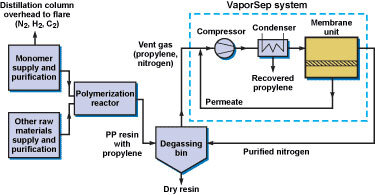
For resin degassing applications, the vent stream is compressed and then cooled to condense the propylene. The gas leaving the condenser still contains a significant amount of propylene. This gas is fed to the membrane unit, which separates the stream into a propylene-enriched permeate stream and a purified nitrogen residue stream. The permeate is recycled to the inlet of the compressor and then to the condenser, where the propylene is recovered. The purified nitrogen stream is recycled to the degassing bin.
For C3 splitter overhead applications, the VaporSep unit is very simple, consisting of membrane modules only, with no moving parts. The stream leaving the column overhead is primarily propylene, mixed with light gases such as N2 or H2. The VaporSep unit splits this stream into a propylene-enriched stream and a light-gas-enriched stream. The propylene-enriched stream is returned to the distillation column, where the propylene is recovered, and the light-gas-enriched stream is vented or flared.
VaporSep units are currently used by major polypropylene producers including Formosa Plastics, Ineos, SABIC, Sasol, and Sinopec.
Benefits
- Recovers valuable propylene with typical payback time of less than 1 year
- Purifies nitrogen for reuse in the process
- Minimizes installation time and expense with skid-mounted construction
- Reduces incineration and flare requirements
- Achieves significantly higher hydrocarbon recovery than possible by condensation alone
- Allows recovery at more moderate temperatures and pressures than condensation alone
- Minimizes footprint and weight
- Creates no secondary waste streams
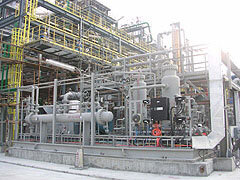
This propylene/nitrogen recovery unit was recently started up in Asia
System Performance
- Suitable for vent streams from 300 to 10,000 lb/h, with propylene concentrations from 10 to 80 vol%
- Propylene recovery up to 99+%
- Nitrogen recovery over 95% with purities of 99+ vol%
System Description
- Complete skid-mounted unit includes membrane modules, compressor, heat exchangers, piping, instrumentation, and controls
- Unit dimensions: 15 ft (L) x 10 ft (W) x 10 ft (H); 5,000 to 15,000 lb; compressor is mounted on a separate skid of similar size
- Conforms to typical petrochemical specifications (ASME, ANSI, PED, TEMA, NEC or IEC etc.)
- Control is by local PLC or through DCS
Frequently Asked Questions
What is a propylene recovery unit and how does it work?
A propylene recovery unit (PRU) is a system used in polypropylene production plants to recover valuable propylene that is otherwise lost in vent streams.
It works by first compressing and cooling the vent gas to condense part of the propylene. The remaining gas is then passed through a membrane system, which separates it into two streams:
A propylene-rich stream, which is recycled back into the process
A nitrogen-rich stream, which is purified and reused
This process enables efficient recovery and reuse of both propylene and nitrogen within the plant.
How does a propylene recovery unit improve process efficiency?
A propylene recovery unit improves efficiency by minimizing the loss of valuable raw materials and reducing waste.
By recovering up to 99% of propylene, the system significantly lowers feedstock costs and increases overall plant profitability. It also reduces flaring and emissions while allowing nitrogen to be reused in the process. Additionally, membrane systems can achieve higher recovery rates than traditional condensation alone, improving overall process performance.
What technologies are used inside a propylene recovery unit?
A propylene recovery unit typically combines multiple technologies, including:
Compression systems – to increase pressure for effective separation
Condensation units – to recover bulk propylene as liquid
Membrane separation technology (e.g., VaporSep®) – to separate remaining propylene from nitrogen
Heat exchangers and control systems – for temperature control and process optimization
The membrane system is the core technology, enabling selective separation of propylene from lighter gases without the need for chemicals or complex operations.
How to optimize the efficiency of a propylene recovery unit in a refinery?
To optimize efficiency, operators should focus on:
Maintaining proper pressure and temperature conditions for optimal separation
Ensuring membrane performance and cleanliness through regular monitoring
Optimizing recycle streams to maximize propylene recovery
Integrating membrane systems with existing compression and condensation stages
Monitoring feed composition and adjusting operating parameters accordingly
Combining condensation with membrane separation is especially effective, as it enables higher recovery rates even at moderate conditions.
How to select the right technology for a propylene recovery unit?
Selecting the right technology depends on several factors:
Feed composition and flow rate
Required recovery efficiency (e.g., 90% vs. 99%+)
Operating conditions (pressure, temperature)
Space and installation constraints
Cost and payback period
Membrane-based systems are often preferred because they are compact, energy-efficient, and capable of achieving high recovery with fast payback. They also offer easier installation and lower maintenance compared to more complex alternatives.