
LPG-Sep™ is a winner because membranes easily get the heavies out of the effluent gas at benign conditions — no cryogenics, no absorbents, no hassle.
Opportunity
Associated gas often cannot be used at remote wellheads and the whole stream has to be flared — wasting a valuable resource and contaminating the environment. LPG recovery from these flare gases saves valuable hydrocarbons and enables them to be used locally.
Membrane Solution
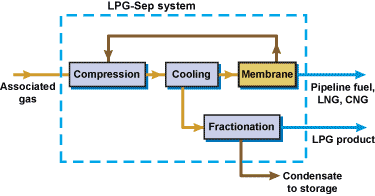
LPG-Sep™ Process
MTR’s LPG-Sep™ systems efficiently recover LPG from associated gas — an attractive option since LPG is easy to store and transport and can often be used locally. Associated gas is rich in heavy hydrocarbons so removing LPG and heavier fractions from the flare gas massively reduces carbon emissions and the bulk of the BTU value in the gas is recovered for local use. In some situations use of LPG-Sep™ enables the remaining methane to be easily recovered in simple LNG or CNG units, to be used as fuel gas or to be piped to a nearby consumer.
LPG-Sep™ unit operations comprise (i) conventional compression to 350 psi;
(ii) cooling and C3+ condensation by chilled water at 60°F;
(iii) membrane gas separation to lean out the gas;
(iv) fractionation to produce spec LPG and condensate.
Benefits
- LPG recovery using simple gas processing at ambient temperature and moderate pressure
- No cryogenics, no absorbents, no chemicals, no effluents
- Unattended operation at remote locations
- Skid mounted equipment, can be trucked to site
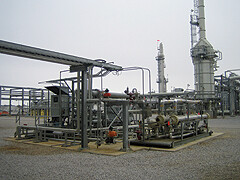
Demonstration LPG-Sep™ unit operating at a US Gulf Coast location
System Performance
- Feed flow rate: 2-50 MMSCFD
- Feed NGL content: 5% to 50%
- LPG Recovery up to 95%
- Typical payback 6 to 18 months
Application Options
- Wellhead LPG recovery
- Dewpointing
- Flare gas recovery
- Debottlenecking
Frequently Asked Questions
How does LPG recovery technology work?
LPG recovery technology combines compression, cooling, membrane separation, and fractionation. The gas stream is first compressed and cooled to condense heavier hydrocarbons (C₃+). It then passes through membranes that selectively separate LPG components from lighter gases. Finally, fractionation produces specification-grade LPG and condensate for use or sale.
Where is LPG extraction technology used?
LPG extraction technology is widely used in applications such as wellhead gas processing, flare gas recovery, dew point control, and refinery or petrochemical streams. It is especially valuable in remote locations where associated gas would otherwise be flared, allowing operators to recover and utilize hydrocarbons locally.
What are the key benefits of modern LPG extraction technology?
Modern LPG extraction technologies offer several benefits, including:
High LPG recovery (up to 95%)
Reduced flaring and lower emissions
Compact, skid-mounted systems for easy deployment
No need for chemicals, absorbents, or cryogenic processes
Quick payback (often within 6–18 months)
These advantages make membrane-based systems efficient, cost-effective, and easy to operate even in remote environments.
Is LPG extraction technology the same as LPG recovery?
Yes, LPG extraction and LPG recovery generally refer to the same process, separating and capturing liquefied petroleum gas (propane, butane, and heavier hydrocarbons) from gas streams. The terms are often used interchangeably in natural gas and refinery applications.
Do LPG extraction technologies require high temperatures or pressures?
No, modern membrane-based LPG extraction systems typically operate at moderate pressures and near-ambient temperatures. They avoid the need for energy-intensive cryogenic processes, making them more efficient and easier to operate in a wide range of conditions.