
MTR is the leading supplier of membrane system for hydrocarbon recovery from petrochemical plant vents.
Opportunity
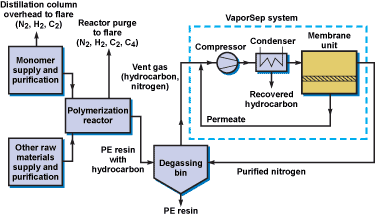
During the production of polyethylene (PE), a portion of the ethylene and other hydrocarbon feedstock is lost. The value of the lost feedstock is substantial, ranging from $1 million to $3 million per year for a typical PE plant. Losses occur primarily at 3 points in the production process: distillation column overhead vents in the ethylene recovery and purification step, reactor purge vents, and resin degassing vents.
VaporSep® Solution
This propylene/nitrogen recovery unit was recently started up in Asia
For resin degassing applications, the vent stream is compressed and cooled to condense hydrocarbons. The gas leaving the condenser still contains a significant amount of hydrocarbon. This gas is fed to the membrane section, which separates the stream into a hydrocarbon-enriched permeate stream and a purified nitrogen residue stream. The permeate is recycled to the inlet of the compressor and then to the condenser where the hydrocarbon is recovered. The purified nitrogen stream is recycled to the degassing bin.
For distillation column overhead and reactor purge applications, the VaporSep unit is very simple, consisting of membrane modules only, with no moving parts. The stream leaving the column or reactor is typically contaminated with light gases such as N2 and H2. The VaporSep unit splits this stream into a hydrocarbon-enriched stream and a light-gas-enriched stream. The hydrocarbon-enriched stream is returned to the distillation column or reactor where the hydrocarbon is recovered, and the light-gas-enriched stream is vented or flared. VaporSep units are currently used by major PE producers including ExxonMobil, Formosa Plastics, SABIC, and Sinopec.
Benefits
- Recovers valuable monomers and other hydrocarbons with typical payback time of less than 1 year
- Purifies nitrogen for reuse in the process
- Minimizes installation time and expense with skid-mounted construction
- Reduces incineration and flare requirements
- Achieves significantly higher hydrocarbon recovery than possible by condensation alone
- Allows recovery at more moderate temperatures and pressures than condensation alone
- Minimizes footprint and weight
- Creates no secondary waste streams
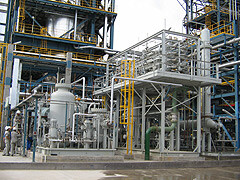
This unit recovers isobutane and nitrogen in a modern polyethylene plant.
System Performance
- Suitable for vent streams from 300 to 30,000 lb/h, with hydrocarbon concentrations from 10 to 80 vol%
- Ethylene recovery up to 99+%
- Nitrogen recovery over 95% with purities of 99+ vol%
System Description
- Complete skid-mounted unit includes membrane modules, compressor, heat exchangers, piping, instrumentation, and controls
- Unit dimensions: 15 ft (L) x 10 ft (W) x 10 ft (H); 15,000 to 50,000 lb; compressor is mounted on a separate skid of similar size
- Conforms to typical petrochemical specifications (ASME, ANSI, PED, TEMA, NEC or IEC etc.)
- Control is by local PLC or through DCS
Frequently asked questions
How is polyethylene produced?
Polyethylene is produced through polymerization, a chemical process in which ethylene monomer molecules are linked together into long polymer chains using catalysts under controlled temperature and pressure. The process begins with sourcing ethylene from steam cracking of hydrocarbons such as ethane or naphtha. The ethylene is then polymerized in gas phase, slurry, or solution reactors. The final step involves extrusion and pelletization of the resin for commercial use. Different grades such as LDPE, HDPE, and LLDPE are produced by adjusting reaction conditions and catalyst systems.
What are the main steps in polyethylene production?
The main steps in polyethylene production include ethylene preparation through steam cracking and purification, catalyst preparation and activation, polymerization in a reactor, separation of polymer from unreacted monomer and solvents, and extrusion and pelletization into resin pellets. Unreacted ethylene and hydrocarbons from vent streams can be recovered using membrane systems such as MTR VaporSep to reduce feedstock losses and improve plant efficiency.
What are the environmental impacts of polyethylene production?
Polyethylene production can generate greenhouse gas emissions due to energy intensive cracking and polymerization processes. Hydrocarbon losses from reactor purge and degassing vents may contribute to air pollution and flaring. Plastic waste at end of life is also a major environmental concern. Modern facilities reduce these impacts by implementing membrane based hydrocarbon recovery systems to capture lost monomers, minimize flaring, and improve sustainability. Recycling and chemical recycling technologies are also helping address plastic waste challenges.
Raw materials required for polyethylene production
The primary raw material for polyethylene production is ethylene derived from steam cracking of hydrocarbon feedstocks such as ethane, propane, naphtha, or gas oil. Additional materials include co monomers such as butene or hexene for LLDPE production, hydrogen for molecular weight control, and nitrogen used as a purge gas during resin degassing. Catalysts and performance additives for UV resistance, color, and enhanced properties are also required.
What catalysts are used in polyethylene production?
The main catalysts used in polyethylene production include Ziegler Natta catalysts based on titanium compounds and organoaluminium co catalysts, Phillips catalysts based on chromium oxide on silica, and metallocene catalysts which are single site organometallic compounds. Ziegler Natta catalysts are widely used for HDPE and LLDPE production. Phillips catalysts are valued for their cost effectiveness and operational simplicity. Metallocene catalysts provide improved control over molecular weight and polymer structure, producing resins with enhanced mechanical and optical performance.