
Key Publications and Presentations:
MTR uses SolvSep™ membrane systems to dehydrate organic solvents widely used in the pharmaceuticals and fine chemicals industries.
Isopropanol (IPA) is widely used as a drying solvent and cleaning agent in the electronics, pharmaceutical, and fine machine parts industries. With use, the IPA becomes contaminated with water, Typically the solution cannot be used when the water content exceeds about 15 to 20 wt% water. Because of the water-IPA azeotrope at 85 wt% IPA, simple regeneration of the IPA by distillation is not possible and many small users send their IPA to a waste solvent recycler. The availability of the MTR SolvSep membrane process offers an alternative for any operator producing more than a few hundred gallons per day of IPA.
In many cases the feed solution to be treated is a mixture of IPA and water, but more complex mixtures can also be treated. For example, a system installed at IPA production plant to treat a ternary azeotrope is shown below.
The feed to the membrane unit was the overhead vapor produced in an IPA production plant. The feed was IPA containing about 6% acetone and 12% water. The membrane unit produced a dry product containing <0.5 wt% water. Essentially complete recovery of the IPA and acetone content of the feed was achieved.
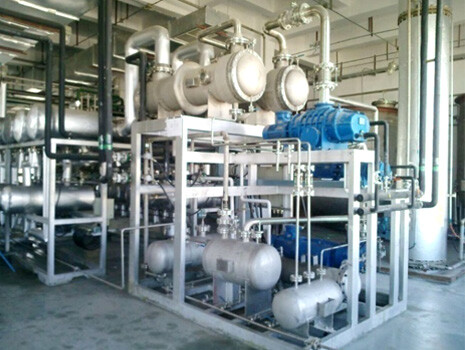
A 70m² 3,500 ton/year IPA production plant
Frequently asked questions
Why is dehydration of isopropanol industrially important?
Dehydration of isopropanol (IPA) is industrially important because IPA is widely used as a cleaning agent and drying solvent in the electronics, pharmaceutical, and precision manufacturing industries. During use, IPA becomes contaminated with water, and due to the water IPA azeotrope at 87.7 wt percent IPA, simple distillation alone cannot achieve the required purity. Membrane based dehydration systems, such as MTR’s SolvSep process using zeolite membranes, provide an energy efficient solution to break the azeotrope, reduce water content to 0.1 to 1.0 wt percent, and enable near complete recovery of dry solvent.
How is isopropanol converted to propene by dehydration?
Isopropanol can be catalytically dehydrated to propene (propylene) and water by passing IPA vapor over an acidic catalyst at elevated temperatures, typically 250 to 375 degrees Celsius. The reaction follows an elimination mechanism where the hydroxyl group and a hydrogen atom are removed from adjacent carbon atoms, forming a carbon carbon double bond. Acidic catalysts such as alumina, zeolites, and heteropolyacids are commonly used to promote dehydration and maximize propylene production.
What catalysts are used for isopropanol dehydration?
Common catalysts for isopropanol dehydration include gamma alumina, zeolites such as USY and ZSM 5, and heteropolyacids like phosphotungstic acid. Strong Bronsted acid catalysts are active at lower temperatures around 350 K, while Lewis acid catalysts such as zirconia and alumina typically require higher temperatures around 450 K. Catalyst selection influences both conversion efficiency and selectivity toward propylene versus acetone.
What safety precautions are required for isopropanol dehydration?
Isopropanol is highly flammable with a flash point of 12 degrees Celsius, so proper ventilation and explosion proof equipment are essential. The reaction produces propylene, which is also flammable and requires leak detection and proper gas handling systems. Temperature and pressure must be carefully controlled to prevent runaway reactions, and standard industrial safety practices including grounding, fire suppression systems, and personal protective equipment must be followed.
What is the difference between dehydration and dehydrogenation of isopropanol?
Dehydration of isopropanol removes water from the molecule to produce propene and water, and it is catalyzed by acidic catalysts. Dehydrogenation removes hydrogen to produce acetone and hydrogen gas, typically using metallic catalysts such as copper. In industrial solvent recovery applications, IPA dehydration may also refer to the physical removal of water from isopropanol using membrane or distillation systems rather than a chemical reaction.