
Frequently Asked Questions
Where are PerVap membrane separation systems used?
PerVap membrane separation systems are used in food processing and water treatment. Examples of applications include the following:
- Recovery of flavor compounds from food industry process streams.
- Recovery of ethanol from fermentation and food industry process streams.
- Removal of organic contaminants from wastewater streams.
How do PerVap® systems work?

Pervaporation process
In the pervaporation process, a liquid mixture contacts the membrane, which preferentially permeates one of the liquid components as a vapor. The vapor enriched in the more permeable component is cooled and condensed, spontaneously generating a vacuum that drives the process. MTR’s pervaporation systems use proprietary membranes to separate dissolved volatile organic compounds (VOCs) from aqueous solutions. The membrane selectively permeates the organic compound, producing a concentrated permeate stream that contains the organic component of interest and an organic-depleted residue stream. The dissolved organic may be a high-value component, such as a food essence, or a contaminant, such as a chlorinated solvent.
What is the payback time for a VaporSep membrane system?
The payback time is typically 6 to 12 months, depending on the application.
What is the lifetime of a VaporSep membrane?
With proper operation and maintenance, a VaporSep membrane should have a lifetime of 3 to 5 years. When replacement is necessary, the membrane module is easily replaced without the need for special tools or expertise.
What is the footprint of a VaporSep membrane system? How much does it weigh?
Large membrane systems may consist of multiple skids and subsystems, such as a compressor package, a dryer package, and a refrigeration package. The footprint of a skid may be as large as 30 feet long by 12 feet wide. Since every system is custom designed, the footprint may be reduced to fit the customer’s requirements. Individual skids weigh as much as 25 tons.
What is a typical turndown ratio?
Membrane systems can be operated down to 20% of design capacity.
What process controls and instrumentation are required?
MTR will provide a standard piping and instrumentation diagram (P&ID) showing recommended control systems and instruments for the membrane and pretreatment equipment. MTR can review and approve customized control systems for special applications.
What preconditioning of the feed gas is required?
Several factors determine the required pretreatment. If dust or other solid particles are present, they must be removed upstream with a high-efficiency filter. If the feed gas contains entrained liquids, a mist eliminator vessel with a high-efficiency coalescing agent is required. MTR will provide detailed pretreatment requirements.
What are the operating limits of VaporSep membrane modules?
The membrane module can operate over a wide range of temperatures and pressures. The temperature range is -40°C to 40°C. The feed pressure can be as high as 1,500 psi. The permeate pressure can be under vacuum if required to achieve a certain separation.
Where are VaporSep membrane separation systems used?
VaporSep membrane separation systems are used in the petrochemical, refining, and natural gas processing industries. Current applications include the following:
- Recovery of olefins from resin degassing vent streams in polyolefin plants.
- Recovery of liquified petroleum gas (LPG) from refinery vent streams.
- Fuel gas conditioning (removal of heavy hydrocarbons from fuel gas).
- Recovery of natural gas liquids (NGLs) from natural gas streams.
How are VaporSep membranes packaged?
VaporSep membranes are manufactured as flat sheets and rolled into spiral-wound modules. The feed gas enters the module and flows between the membrane sheets. Spacers on the feed side and the permeate side of the membrane sheets create flow channels. The hydrocarbon vapor that passes preferentially through the membrane flows inward to a central permeate collection pipe. The light gas (nitrogen, hydrogen or methane) is rejected by the membrane and exits as the residue.
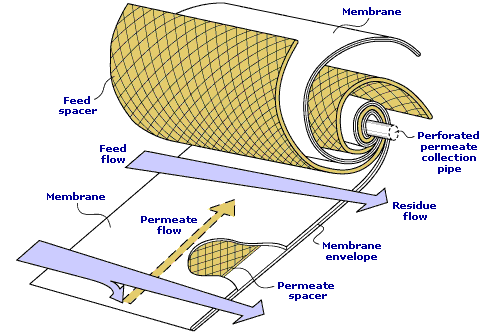
Spiral-wound membrane module
Modules are 3 feet long and 4 to 8 inches in diameter. As many as 4 modules are placed in pressure vessels designed to meet local standards (ASME, etc). To meet the needs of a particular application, modules are configured in series and parallel flow combinations.
How do VaporSep membranes work?
VaporSep membranes separate gas mixtures on the basis of solubility. Large hydrocarbon molecules with greater solubility in the membrane permeate much faster than smaller, less soluble molecules such as nitrogen, hydrogen, or methane.
By comparison, conventional membranes separate gases on the basis of size. Small molecules are selectively permeated because they diffuse through the membrane more rapidly than large molecules.
How does the VaporSep® process work?
The VaporSep process combines a compression-condensation step with a membrane separation step. The feed gas – a mixture of hydrocarbons in nitrogen, hydrogen, or methane – is compressed and cooled, condensing a portion of the hydrocarbons in the gas. The liquid hydrocarbons are recovered; the remaining gas, which still contains significant amounts of hydrocarbons, is fed to the VaporSep membrane. The membrane separates the gas into a hydrocarbon-rich permeate stream and a hydrocarbon-depleted residue stream (the purified gas). The permeate is recycled to the compressor; the residue stream is vented or reused.
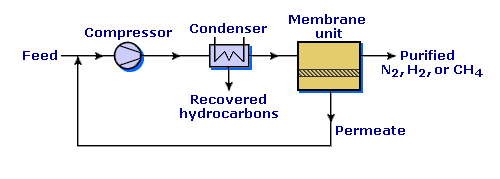
VaporSep process
When my company invests in a membrane system from MTR, what does it get?
For each application, MTR:
- Manufactures membranes and spiral-wound modules.
- Selects and procures all system components, including compressors, pumps, heat exchangers, vessels, instruments, and controls.
- Designs piping and system layout.
- Supervises skid fabrication.
- Inspects and tests the equipment before shipment.
- Trains the operators and commissions the system.
- Guarantees the performance of the entire system.
In summary, MTR does everything from initial concept to commissioning except the field installation work.
How do I find out if a membrane separation can improve the economics of my process?
Contact us by phone, by e-mail, or submit your request using one of our online inquiry forms. We will get back to you as soon as possible.
- Telephone your local sales agent.
- Scan a diagram and send it as an e-mail attachment together with a description of your process to sales@mtrinc.com.
- Select and complete one of our online inquiry forms on the Contact Us page.
What are the benefits of including an MTR membrane system in my process?
MTR’s membrane systems enable operators to do the following:
- Recover valuable raw materials, such as olefins.
- Purify and recycle purge gases, such as nitrogen and hydrogen.
- Reduce emissions.
What is membrane separation and how does it work?
Membrane separation is a physical process that uses a semi-permeable membrane to selectively separate components in a gas or liquid mixture based on differences in molecular size, charge, or chemical affinity. A pressure difference across the membrane acts as the driving force, allowing certain molecules to pass through (permeate) while retaining others (retentate). This technology is widely used in industries like petrochemical, natural gas processing, and water treatment for applications ranging from gas purification to solvent recovery.
What types of membrane separation techniques are there? (e.g., UF, NF, RO)
The main types of membrane separation techniques include microfiltration (MF) for removing suspended solids and bacteria, ultrafiltration (UF) for filtering proteins and macromolecules, nanofiltration (NF) for removing dissolved organics and divalent ions, and reverse osmosis (RO) for desalination and removing virtually all dissolved particles. Additionally, gas separation membranes are used in industrial applications such as hydrogen recovery, CO₂ removal, and hydrocarbon recovery from petrochemical and natural gas process streams.
How does pressure affect membrane separation performance?
Pressure is the primary driving force in membrane separation, as it pushes molecules through the membrane’s selective barrier. Higher applied pressure generally increases the permeation rate (flux), allowing more material to pass through the membrane per unit time. However, excessively high pressure can accelerate membrane fouling and reduce membrane lifespan, so operating pressure must be carefully optimized for each application.
How to choose the right membrane for a specific separation task?
Choosing the right membrane depends on several key factors: the size and type of molecules you need to separate, the required purity level of the product, and the operating conditions such as temperature, pressure, and chemical compatibility. You should also consider the feed composition, desired recovery rate, and whether you need to handle aggressive chemicals like H₂S or CO₂. Consulting with a membrane technology specialist, such as MTR (Membrane Technology and Research), can help match the optimal membrane material and system design to your specific process requirements.
Difference between membrane separation and traditional separation methods?
Membrane separation is a purely physical process with no phase change, no chemical additives, and no heat required, making it simpler and more energy-efficient than traditional methods like distillation, absorption, or cryogenic separation. Traditional methods often involve large equipment footprints, high energy consumption, and complex operations with moving parts. Membrane systems are compact, modular, easy to install, and can operate unattended, making them ideal for remote or offshore locations.
What are the applications of membrane separation?
Membrane separation is used across a wide range of industries including petrochemical plants for hydrocarbon and monomer recovery, natural gas processing for CO₂ and H₂S removal, refineries for hydrogen purification, and water treatment for desalination and wastewater reuse. Companies like MTR (Membrane Technology and Research, Inc.) have deployed over 450 membrane gas separation systems worldwide for applications including polyethylene production vent recovery, fuel gas conditioning, nitrogen removal, and solvent dehydration.
What is a hydrocarbon recovery system and how does it work?
A hydrocarbon recovery system captures valuable hydrocarbons, such as ethylene, propylene, and other monomers, from industrial vent and purge gas streams that would otherwise be flared or lost to the atmosphere. These systems typically use membrane technology (such as MTR’s VaporSep®) to separate hydrocarbons from light gases like nitrogen and hydrogen based on differences in permeation rates through the membrane. The recovered hydrocarbons are recycled back into the production process, reducing raw material costs and improving plant profitability.
Types of hydrocarbon recovery systems used in the oil & gas industry.
The main types of hydrocarbon recovery systems used in the oil and gas industry include membrane-based separation systems, cryogenic recovery units, absorption-based systems (using lean oil or refrigerated solvents), and pressure swing adsorption (PSA). Membrane systems like MTR’s VaporSep® are increasingly preferred for petrochemical applications because they are compact, have no moving parts, require minimal maintenance, and offer fast payback, typically less than one year.
What problems does a hydrocarbon recovery system solve?
Hydrocarbon recovery systems solve the problem of valuable feedstock being wasted through flaring or venting at petrochemical plants, refineries, and gas processing facilities. In polyethylene production alone, feedstock losses from distillation column overheads, reactor purges, and resin degassing vents can range from $1 million to $3 million per year per plant. These systems recover that lost value while also addressing environmental compliance requirements by reducing volatile organic compound (VOC) emissions and flare loads.
How hydrocarbon recovery helps reduce flaring and emissions?
Hydrocarbon recovery systems directly reduce flaring by capturing hydrocarbons from vent streams and recycling them back into the process instead of burning them at the flare. This significantly lowers CO₂, methane, and other greenhouse gas emissions associated with routine flaring. For example, MTR’s membrane-based VaporSep® systems recover more than 90% of vent hydrocarbons, which drastically cuts the volume of gas sent to the flare and helps operators meet increasingly strict environmental regulations.
What are the main components of a hydrocarbon recovery system?
The main components of a membrane-based hydrocarbon recovery system include a compressor to pressurize the feed gas, a condenser and gas/liquid separator to remove condensable hydrocarbons, membrane modules that selectively separate hydrocarbons from light gases, and associated piping, instrumentation, and controls. MTR’s complete VaporSep® units are skid-mounted for easy installation, handling vent streams from 300 to 30,000 lb/h with hydrocarbon concentrations of 10 to 80 vol%.