
Key Publications and Presentations:
The N2 removal membrane system works very well and is very simple to operate
Challenge
Nitrogen is a common contaminant in natural gas and is quite difficult to remove. Nitrogen lowers the BTU value of the gas and makes it unsaleable to most pipelines. Natural gas will be accepted for transport by pipeline only if it contains less than a specified amount of nitrogen, typically somewhere between 4% and 6%.
Cryogenic nitrogen removal is complex and prohibitively expensive at modest scale. MTR’s membrane based NitroSep™ system is a proven and economical solution.
Example
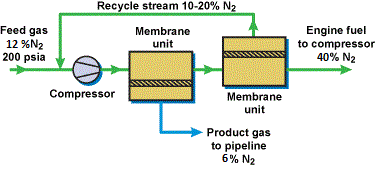
Nitro-Sep™ Process
MTR’s NitroSep™ system produces pipeline-quality or pipeline-acceptable gas and a nitrogen-rich fuel from raw natural gas. The proprietary membranes are significantly more permeable to methane, ethane, and other hydrocarbons than to nitrogen.
Gas containing 8% to 12% nitrogen is compressed and passed across a first set of membrane modules. The permeate, which contains 6% nitrogen, is sent to the pipeline; the nitrogen-rich residue gas is passed to a second set of membrane modules. These modules produce a residue gas containing about 40% nitrogen and a nitrogen-depleted permeate containing 10% to 20% nitrogen. The residue gas is used as fuel; the permeate is mixed with the incoming feed gas for further recovery.
Benefits
- Bulk Nitrogen content reduced to pipeline specification
- Heavy hydrocarbons captured in the product gas
- Easy, low-cost installation; system can be installed in 1-2 days
- Membrane unit requires low maintenance; robust long-lasting membranes
- System is easily moved from one location to another
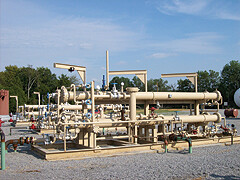
NitroSep™ units upgrading high nitrogen gas in California
System Performance
- Feed rate: Wide range upto 200+MMSCFD
- Feed N2 content: 4% to 50% (Bulk Reduction)
- Target N2% or BTU value
- Hydrocarbon BTU recovery : >90%
Frequently Asked Questions
What are the benefits of membrane-based nitrogen removal systems?
Membrane-based systems offer several advantages:
Reduce nitrogen to pipeline specifications
High hydrocarbon recovery, preserving valuable gas components
Low installation cost and quick setup
Minimal maintenance with no moving parts
Flexible and portable systems for different locations
How efficient is nitrogen removal with membrane systems?
Membrane systems are highly efficient, capable of:
Treating gas streams with 4% to 50% nitrogen content
Achieving pipeline-quality gas output
Delivering over 90% hydrocarbon (BTU) recovery
This makes them a reliable and economical solution for improving natural gas quality.
Why is nitrogen removed from natural gas?
Nitrogen is removed because it reduces the heating value (BTU) of natural gas, making it less efficient and often unsuitable for pipeline transport or sale. High nitrogen content dilutes the energy content, so removing it ensures the gas meets commercial and pipeline quality standards.
What are the common methods for nitrogen removal?
The most common methods for nitrogen removal from natural gas include:
Cryogenic distillation – effective but complex and expensive
Pressure Swing Adsorption (PSA) – suitable for certain conditions
Membrane separation – a simpler, cost-effective solution, especially for small to mid-scale operations
What nitrogen levels are acceptable for pipelines?
Most natural gas pipelines require nitrogen content to be below approximately 4% to 6% to meet quality specifications. Gas exceeding this limit must be treated before it can be transported or sold.